On Sunday morning, I traveled with a Tantur group to Sunday Mass at a Benedictine Monastery and its church, St. Mary’s of the Resurrection, in Abu Ghosh, an Arab village west of Jerusalem. In the half-hour it took to get there, our Librarian at Tantur (herself a native of France who has spent time at this monastery) told us about the history of the place and the two communities who live there, both French: a community of nuns headed by the Mother Prioress, and a community of monks and priests, headed by the Father Abbot. We also listened to the Mass readings in English, as the Mass would feature these readings in French.
The community’s ministries are three-fold: (1) the usual prayer, work and hospitality of any Benedictine community; (2) ecumenical outreach, especially to the many Eastern Orthodox churches in the region; and (3) outreach to local Muslims in the village of Abu Ghosh.
This is my kind of place! Men and women religious, side by side; and working both ecumenical and interfaith engagement — exactly what I think we need to heal the world.
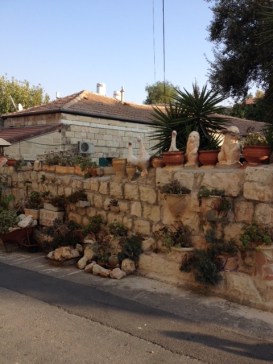
Before Mass, we wandered around the “Meditation Gardens” that surround the Abbey — lush gardens with palm, olive and lemon trees, grape vines, and every manner of growing and flowering plants. Stone walls line the walkways, and it is a place of great serenity and beauty.
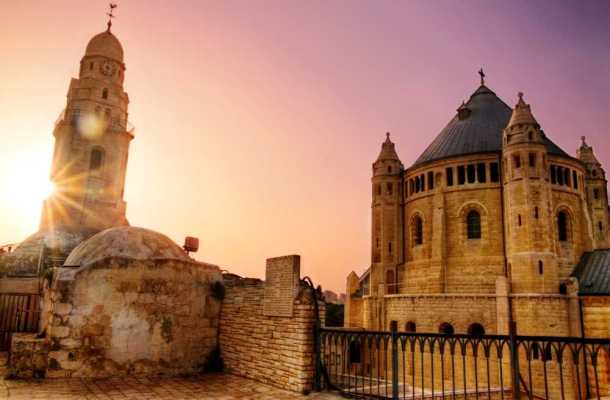
Here are some photos I took. Notice the minaret in the center photo, its tower just barely peeking out on the left of the Abbey turret, seemingly side by side with the Abbey (but in fact, some distance away in the village).


The Church itself was built in 1143 by Crusaders (Hospitaller Order of St. John, now the Knights of Malta). It was built on earlier Roman ruins, but archeological evidence and biblical references document human activity on this site for at least 6000 years. A spring of fresh water helped draw and keep civilization after civilization there.
The Crusaders believed they built the Church on the site of the encounter with the risen Jesus at Emmaus described in the Gospel of Luke (Ch. 24, v. 13-35). In fact, scholars still debate the location of that biblical story. The Church and property were given to France in 1873, and in 1900, a monastery was added. Various orders of French monastics occupied the monastery since then, until the current order of nuns, monks and priests arrived from Normandy in 1976. As with all Benedictines, hospitality is central to their ministry, and they welcome visitors warmly.
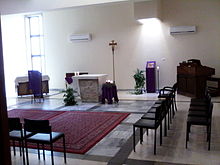
The interior of the Church is beautiful, with some of the frescos preserved from the 12th century. The photo below shows the interior of the Church, just as it looked to me, a visitor in the rows of benches toward the rear of the church. The monks and nuns (as well as a few priests in our group who were welcomed to concelebrate the mass) were seated choir style in the wooden seats shown in the photo.
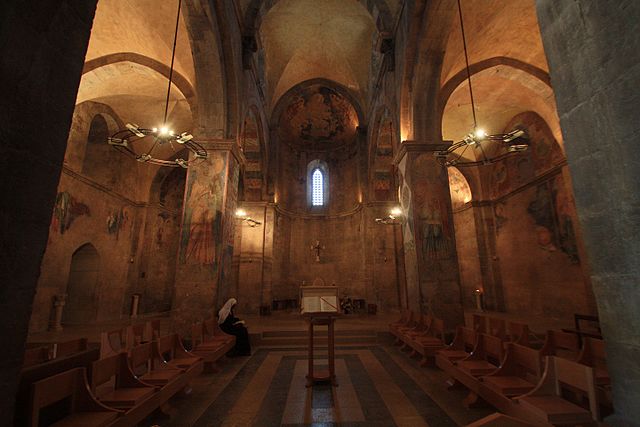
It was a beautiful mass, with nuns and monks as well as the priests serving roles in the liturgy. Every part of the mass was sung, all of it in either French or Latin (I could even sing along with some of the Latin!). When the the Gospel was sung by the presiding priest, one of the nuns played an oud, a very special stringed instrument owned by the Abbey (ouds are one of a huge family of stringed instruments used in various places throughout the Middle East).


I felt so much “at home” at this abbey, maybe because of all the orders of religious, I know the Benedictines best, having spent time for years with the Benedictine Sisters of Erie, Pennsylvania. I most certainly hope to go back to Abu Ghosh, and explore the village as well as spend more time at the Abbey before I leave Israel in the spring.
The Abbey has a wonderful (and unusual) website, if you’re interested in exploring more: https://abbaye-abugosh.info/en/home/




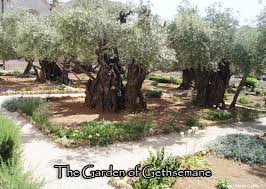
 Photo by Diana Sayegh, Tantur staff.


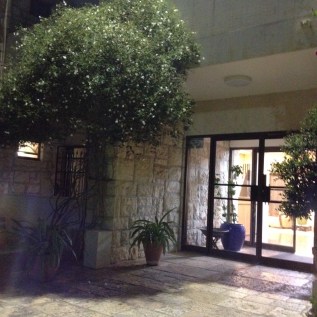 The image here is the front entrance to the Tantur Ecumenical Institute but I would have to post a dozen photos to give you a sense of the place. I chose this one because it shows a bit of the lushness of the place, even evident at night. I breathe in the intoxicating aroma of the Jasmine tree that stands on the left side of the door. Rose bushes are everywhere. We also have scores of olive trees; plus pomelo, lemon, lime, cherry, apricot and other fruit trees as well as vegetables. These are all used by the cooks who prepare our meals.
 Crossroads