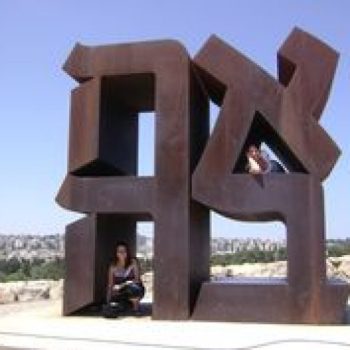
This very week marks three important anniversaries here in Israel, all of them resulting in much pain and conflict. In public ceremonies recognizing these historic events, the mood is somber and public figures speak of “commemoration” not “celebration.” Let me recognize also that some of you — dear Crossroads readers — know far more than I do about these events and their aftermath, while others of you have had little reason to know these histories. So I dare to write because they have commanded so much public attention and debate throughout the world but most particularly here in Israel.
October 31, 2017 – 500th anniversary of Martin Luther’s 95 Theses nailed on the Wittenberg Cathedral door. We’ve had many commemorative events including a lecture here at Tantur and a culminating observance, a worship service on October 31 at the Lutheran Church of the Redeemer in the Old City of Jerusalem.
The lecture was fascinating: a Luther scholar from Finland and an ordained Lutheran cleric (and university administrator) discussed Luther’s views of the “Other Children of Abraham” — namely Jews and Muslims. It’s not pretty. Though I knew this would be the case, I’m no scholar of Luther and the actual quotes from his published work were quite shocking to me.
In fact, I felt embarrassed to hear those words spoken aloud when I knew our audience included at least one Jew, a member of the staff here at Tantur. Afterward, he told me he had read Jewish scholars who wrote equally venomous condemnations of Gentiles. Regardless, it seems to me that the power differential during centuries of Christian persecution of Jews meant that Luther’s words ranked higher on the “Despicable Scale.”
It was also fascinating to hear that Luther never expected the Pope to be so outraged as to excommunicate him; rather Luther thought he would be able to drive reform from within the Roman church. The scholars theorized that because the Pope was also fighting the Crusades for dominance in the Holy Land, he was driven to excommunicate Luther because he didn’t want dissension in his own ranks that could weaken his position. At the same time, we learned that the leader of the Turks in the battles for the Holy Land, Suleiman, developed an abiding interest in learning more about Luther – a classic case of “the enemy of my enemy is my friend!”
The scores of Christian sects that emerged from the metaphorical (and sometimes actual) fires of the Protestant Reformation all seem to have a stake here in the Holy Land. Along with many heartfelt ecumenical efforts, we also have endless conflicts and shifting bargains over who gets to do what, and when at all the Christian holy sites.
November 2, 2017 – 100th anniversary of the Balfour Declaration, an act of arrogant colonialism by the British, who literally claimed the right to determine the future of the land then known as Palestine, now Israel. The Declaration — a letter by British Foreign Secretary Lord Arthur Balfour to a leading British Zionist, Baron Lionel Walter Rothschild — declared British support for a homeland for the Jewish people. It laid the foundation for the 1948 creation of the modern state of Israel.
It also said clearly that “nothing shall be done which may prejudice the civil and religious rights of existing non-Jewish communities in Palestine” but that promise has not been kept. Both Christian and Muslim Arabs view the Declaration with wrath. Among Jewish sects, the liberals (Reform & Conservative) are frequently embarrassed and apologetic, while the ultra-Orthodox think it didn’t go far enough.
In the lead-up to the 100-year anniversary of the Declaration, the British government admitted that the Balfour Declaration should have explicitly protected the civil, political and religious rights of the people who lived there before Israel was created, but I think the statement in the original Declaration actually does state that clearly. The problem is that the commitment has not been honored.
The decades that followed the Declaration saw increasing migration of Jews to Palestine, even more so after World War II in the aftermath of the Holocaust. While many Jews see the establishment of Israel as at least some reparation for the unspeakable crimes of the Holocaust, the Muslim and Christian Arabs (Palestinians and others) were not perpetrators of the Holocaust but were disenfranchised from their own land. The bitter fruit of the Balfour Declaration still poisons and thwarts diplomatic efforts in this land.
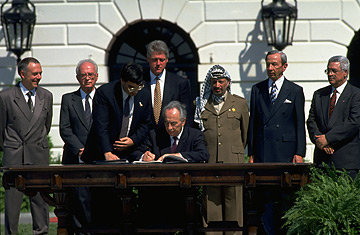
November 4, 2017 — 22nd anniversary of the assassination of Yitzhak Rabin, then Prime Minister of Israel for the second time, having served as PM in the 1970s. Rabin was vigorously pursuing peace with Arabs through the process that came to be known as the Oslo Accord. Ironies over his death abound, and still resonate today in Israel, along with great sorrow over missed opportunity.
The assassin was Yigal Amir, a law student at Bar-Elon University and a right-wing radical who was enraged by Rabin’s concessions in pursuit of the peace accord and who claimed justification under Jewish law, a claim rejected by rabbinical scholars. In Israel’s political scene at the time, Benjamin Netanyahu, the current Prime Minister of Israel, led the opposition to the peace accord and some accused him of inciting the violence that led to the assassination, a charge that Netanyahu vigorously denies.
The murder took place as Rabin led a public rally to build support for the Oslo Accord. The assassin fired 3 shots and was subdued almost immediately by people in the crowd. Rabin was rushed to the hospital but died on the operating table within 40 minutes. In his pocket were the blood-stained lyrics of a famous Israeli peace song, Shir LaShalom which you can listen to here (with English subtitles):
https://www.youtube.com/watch?v=Sz8O0OcAA3c
Some believe all hope for peace died with him. Others refuse to give up, and the echoes of the disagreements over how and whether to achieve peace still mingle with the hope for peace, even in the negotiations over the details and language of the commemoration of Rabin’s death that will take place on November 4.
==========================================================================
The coinciding ceremonies and other public events for these three anniversaries, all in the same week, are a poignant reminder of how far we have to go, how urgently we must go to forge peace in the Holy Land.

 Crossroads
Thank you, Kathy, for this insightful commentary, and for the information that you’ve shared. I, for one, would never have known, or at least thought about, the impact of these events.
Your words are really appreciated!
LikeLiked by 1 person
Thank you so much for letting me know, Margie. I’m honored that you are reading my blog and even more that you found it useful. It’s hard to convey how deeply complex things are here, and how vulnerable are the threads of hope for peace.
LikeLike
Thank you!, Kathy, for this informative article. There was talk of the Balfour Declaration on NPR yesterday, but I have to say it was new to me.
LikeLiked by 1 person
Thank you for reading, Kathy! I’m heartened to know that NPR produced a story about the Balfour Declaration. Things are so complex here, and many people don’t really know about the complex history of the region in the century before modern Israel was formed in 1948. I’m going to look for that NPR program and hope to hear it online.
LikeLike