One benefit of living at Tantur is the multitude of clergy here for various programs, and from various faith traditions. One can worship with others almost every day — Catholic masses, Syrian Catholic, Anglican, masses in Greek or French, other Christian services as well as prayers in Jewish or Muslim traditions. The opportunities are nearly endless.
Last week, however, I joined two masses that were both remarkable and moving, and could not be more different.
The Church of the Holy Sepulcher in Jerusalem’s Old City is one of the holiest sites in Christendom, believed to be the site of the tomb of Jesus. As one enters, a flat stone slab greets you, usually surrounded by worshippers who touch it, venerate it, believing it to be the stone upon which Jesus’ body was anointed before placement in the tomb.

Almost all day from 9 am onward, the Church is crowded with people, tourists and locals alike. In the innermost part of the church, is a chapel with an outer chamber (small) and an inner chamber (tiny) that are believed to be the actual tomb of Christ. This innermost two-chamber “tomb” has been adorned and decorated in marble, gold, precious stones, candles and lamps — hardly the way it would have looked in the time of Jesus. Never mind that assertions about the tomb are disputed by scholars — these places have been sanctified by the prayers of the faithful.
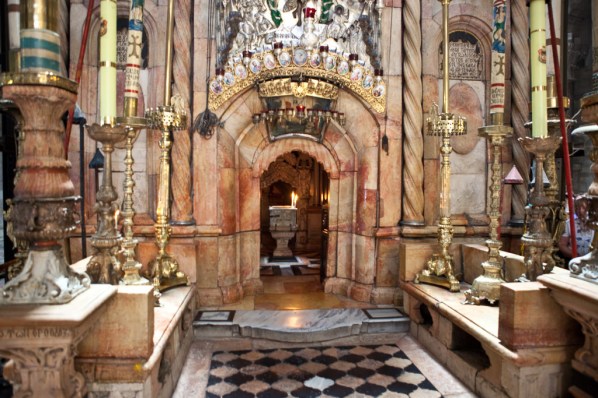
Most of the time, the line to enter those chambers snakes around the outer expanse of the church, hundreds of people waiting for their chance to enter the two-room “tomb.” Very early in the morning, however, one might encounter few crowds, and indeed, groups with a priest may make a reservation to celebrate mass there. Ours was at 6 a.m. last Wednesday, so we left Tantur in our shuttle bus in the dark, then walked through the quiet streets of the Old City to get to the church. The Continuing Ed Group, as we call them, here for a 3-month program of retreat and learning, includes 5 priests.
All of them robed, one of them was the main celebrant while the others took turns standing beside the primary celebrant at the altar in the tiny inner chamber during the mass. The rest of us (20 or so, including several faithful who just happened to be in the church and joined our group) stood in the small outer chamber, and each of us took a turn to go (bent from the waist to clear the tiny door) and stand with the celebrants at the inner chamber’s altar. At the Eucharist, the priests came out of the inner chamber to serve communion to all of us who stood in the outer room.
It was in all respects, right down to the English language, the mass with which I’m so familiar, yet it was a mass like no other I had ever joined. It was over in a half-hour, and we cleared out to make way for the next group and their reservation. After another 30 minutes or so of quiet reflection, we emerged from the Church into the streets, first of the Old City, then the more modern parts of the City, which were filling gradually with people beginning their morning, and on that particular day, large groups and families of Orthodox Jews streaming their way to synagogues to celebrate another day of Sukkot, the week-long Jewish festival that ends the autumn Jewish holidays.
Three days later, the second liturgy: in Arabic. Every Saturday evening, a local Palestinian Catholic community uses Tantur’s chapel to celebrate their vigil Mass.
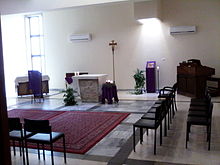
The chapel in this picture looks a bit forlorn and even cold. The Palestinian Catholic community, though numbering only about 20, fill it with warmth and joyful song. I had attended this mass the previous week, so I knew what to expect (I thought).
Last week, two religious sisters in habits were enormously welcoming but seemed a bit worried that perhaps I and Brother John (one of the Continuing Ed group) had stumbled into something we didn’t understand. They spoke to the priest, a Franciscan in his brown robes and sandals, who came to us and spoke in English: did we understand the mass is in Arabic?
Oh yes, we said, we wanted to join them. No problem, I’ve always liked going to masses in other languages. The mass is always the mass, you know what’s going on even if you don’t understand the local language. After all, I grew up with the Latin mass!
Among the 20 people attending were older and younger men, families with small children, women ranging from older teens to the very elderly. The singing was hearty and beautiful, echoing off the marble walls of the chapel. A couple of the songs John and I even knew by melody if not the Arabic words. One family with children contributed their boy — perhaps 7 or so — to ring the bells at the Consecration and to pass the donation basket, tasks he obviously enjoyed enormously — his beaming smiles could’ve lit the room in pitch dark!
This past Saturday evening, I attended that mass again, this time with another of the Continuing Ed group, Sister Agnes from Hong Kong. She had the Order of the Mass on her handheld tablet, in Chinese. After brief consultation with the Arabic-speaking sisters, the same ones who had welcomed us the previous week, the priest (a different one this time) brought me an English Bible, opened to the New Testament Reading for that vigil mass (in this case, one of Paul’s letters to the Philippians) and asked me to read it, in English, at the right time in the mass.
I hesitated — I’m a lector, and I love to read for masses, but if I read in English, wouldn’t there be members of the congregation who wouldn’t understand? No matter, said the priest — they have their own “Order of the Mass” and indeed, I had noticed that the week previous — everyone followed along with the Arabic text of the readings, the responses, the lyrics of the songs in their weekly mass leaflets.
So the priest celebrated in Arabic, songs rang out in Arabic, the congregation gave Arabic responses. One layman in the congregation read the Old Testament portion in Arabic, and then gestured me to the podium for my English reading of Paul. Exchanging the Sign of Peace could not have been more authentic, fully understood no matter the language — As-salamu ‘alaykum.
It was an extraordinary gesture of hospitality to include me in their Eucharistic celebration — truly a communion.

 Crossroads
So glad for your experiences and for sharing them. You underscore an important point about hospitality. Would that it were practiced more widely especially in the institutional church. Enjoy! Thanks, Mary E.
Mary E. Hunt, Ph.D. Pronouns: she, her, hers Women’s Alliance for Theology, Ethics and Ritual (WATER) 8121 Georgia Ave. #310 Silver Spring, MD 20910-4933 USA 301 589-2509 | 301 589-3150 fax mhunt@hers.com Skype: maryhunt1 http://www.waterwomensalliance.org Donate to WATER | Sign up for WATER emails Combined Federal Campaign CFC # 23819
>
LikeLiked by 1 person
I’m so glad you are reading my pieces, Mary. I got a lovely letter from one of the VGS board members too, so I know you have shared it with some of your colleagues. You always get to the heart of the matter too — sometimes I think I’m too timid, with an abundance of caution not to offend anyone here…
LikeLike
What wonderful experiences with the universality of the mass, and the different expressions it takes! Thank you for sharing this. I just finished Fr. James Martin’s “Jesus – A Pilgrimage,” a book he wrote after spending two weeks in the Holy Land visiting sites, real and proclaimed. While the book seemed a little wordy, I did appreciate his commentary on the places Jesus travelled, the alleged location of miracles, the Church of the Holy Sepulcher, etc. Your insight and experiences continue to shed light on this rich and complex area. I’m happy that you were asked to be a lector — what a wonderful sharing! Thank you, Kathy!
LikeLiked by 1 person
Thank YOU, Margy! I feel honored and blessed that you and others are actually taking the time to read my commentaries. This whole experience is just a privilege I never expected to have in life!
I read Fr. Martin’s book, “Jesus–A Pilgrimage” too, a few years ago before I came here in 2015… I like his writing very much, have read several of his books…
LikeLike
Thanks, Kathy! I am so happy for your experience, and grateful you are sharing it with us. 🙂
LikeLiked by 1 person
Thank you Kathy for your updates. I find your entries enlightening and uplifting. Keep up the good work. Sounds like you are having a wonderful experience. I love the sense of Ecumenism that rings out in your writings.
Stay well, my friend.
Frank
LikeLiked by 1 person
So good to “see” you here on my blog, Frank! I’m honored. I hope you, Marie and I can get together when I get home. These blog writings are, as you can imagine, barely a tiny fraction of the abundance I’m experiencing here. Blessings to you and Marie…
LikeLike
You will never be the same! I know that this journey has touched you to your very core. When I read your words I feel as though I am right with you. Thanks Kathy
LikeLiked by 1 person
I wish you WERE right here with me, Mary! If I remember correctly, though, you have been in the Holy Land at least once in the past, so you can probably see in your mind’s eye many of these things I’m describing. Truly a once-in-a-lifetime opportunity for me! Blessings to you and all the ECHO community…
LikeLike
I lost my first response. I don’t know what it is with WordPress but I never can just sign in and out! I have to get a new password every time! But, I shouldn’t take up this space complaining! I loved to hear/read about your experiences in the two different liturgies. It seems they both have a permanent community but it changes all the time because of tourism. That in itself is an interesting concept. I am curious about the Eucharist. What do they use for bread? Since both were Catholic, my assumption is that there was wine, not juice. Wonder if there is a way to hear the music? It would be great to hear what is used in worship. Thanks for all your work in keeping us up to date. Love your writing, Kathy.
LikeLiked by 1 person
I don’t know what’s with the WordPress site, Pat. It shows me that I have both “Followers” and “Email Followers” but I have no idea what’s the difference between those two, or how some got into one group while others are in the second one. The system seems to seize up when I look at the second group, and I haven’t yet been able to see all 30-some who are in that group, so I don’t know — you might be in there twice, and could that explain the difficulty you have using the site? I’ll try to find out.
At the Church of the Holy Sepulcher, there are communities of nuns and monks who have a kind of “caretaker” status and they take care of the scheduling of liturgies, etc., but other than that, there is no permanent community of worshipers at that Church. Thousands of people pass through every day.
The Arabic Catholic community, however, is like a parish community — same people every week, except they have more than one priest who serves their community by presiding at mass each week (and presumably other parish needs like baptisms, weddings, etc.
All of the Churches of every denomination here in Jerusalem (and perhaps throughout many parts of Israel) are accustomed to having visitors (tourists and also people here for longer times like the scholars and volunteers at Tantur). I’ve heard other stories about how these parish or church communities work to accommodate these legions of visitors to the Holy Land.
As for the Eucharist — I’ve been able to join a mass almost every day (partly because of that Continuing Ed. group that includes 5 priests, and they’ve been scheduling daily masses when they’re not traveling). So far, the Eucharist has always used the manufactured flat white hosts that we are accustomed to in ordinary parish communities throughout the US. (I say “ordinary” because my parish, led by a Roman Catholic Womanpriest and her husband — uses small flat loaves of wheat bread that someone in the parish bakes according to some recipe that our priests have provided.
Music! Somehow, I’m not sure I should try to record the music of the Arabic mass, but it’s theoretically possible with my iPhone — I’ll ask someone like the Rector to see if he thinks this would be considered improper.
You ask provocative questions, Pat!
LikeLike